A Photo Essay by Indian Youth
A project of What Kids Can Do and Adobe Youth Voices
Edited by Barbara Cervone
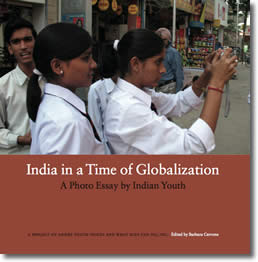 |
|
May 2008 — Paperback — 88 pages, color photographs —ISBN: 0-9762706-9-2 — $9.95 (USD)
ORDER Click on the "Buy Now" button below the book cover.
Growing up in a swiftly developing India, a new generation of young people has questions about its present and their future.
What jobs await them? Will their cultural traditions thrive, or fade away? How is family life changing in a round-the-clock globalized era?
A new book gives compelling and colorful answers in the form of a 94-page photo-essay created by students from New Delhi and Bangalore. India in a Time of Globalization was produced by What Kids Can Do, Inc. with support from Adobe Systems, Inc. as part of its international initiative, Adobe Youth Voices.
With tape recorders and cameras, the young photo-journalists went into their communities looking for evidence of how their world is changing. They interviewed auto-rickshaw drivers and scientists, call center workers and business professionals, finding the stories behind the economic data of India’s recent transformation. Most were holding a camera for the first time as they snapped stunning digital color photographs of people and scenes in streets, parks, markets, and the workplace.
In Bangalore, eleven students from the Government High School at Cotton Pet joined the project as photographers; most were between 11 and 14 and came from a slumdwellers neighborhood. Thirteen students in their mid-teens, from the Noida Public Senior Secondary School, also recorded and transcribed interviews, learning much about journalism as they approached people in all walks of life. In New Delhi, seven students from the Child Rights Information Centre of Bal Panchayat documented the challenges facing children and families, through photographs and research.
Students and their teachers worked closely with a photographer and an editor who visited all three sites from What Kids Can Do (WKCD), a U.S. nonprofit organization documenting “powerful learning with public purpose” by youth around the world. WKCD also wrote the captions that accompany the students’ photographs, combining journalistic research with quotes from interviews by students.
“It seems fitting and important to enlist the next generation as social documenters of a changing India in this time of rapid globalization,” commented Naresh Gupta, managing director of Adobe India, in the book’s introduction. “They come with an open mind and fresh opinions— and this is the world they are inheriting.”
Many of the youthful participants spoke of how much they learned from the project. “We are a country of contradictions,” said one student from New Delhi. “We are the world’s oldest democracy, but we are divided by caste. We are one of the world’s fastest growing economies, but one of its poorest. We are filled with national pride, but see so much that needs correction.” The young photographers snapped more than 5,000 images in the course of the project.